
Consent & observe
Organize authorized neural recordings, participant reports and ordinary task outcomes while preserving timestamps, data provenance and withdrawal controls.
A consented observation record. No modulation.A research question at the intersection of neural interfaces, adaptive AI, and the White Noise Computer vision.
 AI CONCEPT VISUALISATION · NO MEASURED NEURAL DATA
White Noise proposes investigating whether a future model could modulate small neural circuits to make reported remote-viewing experiences available on demand.
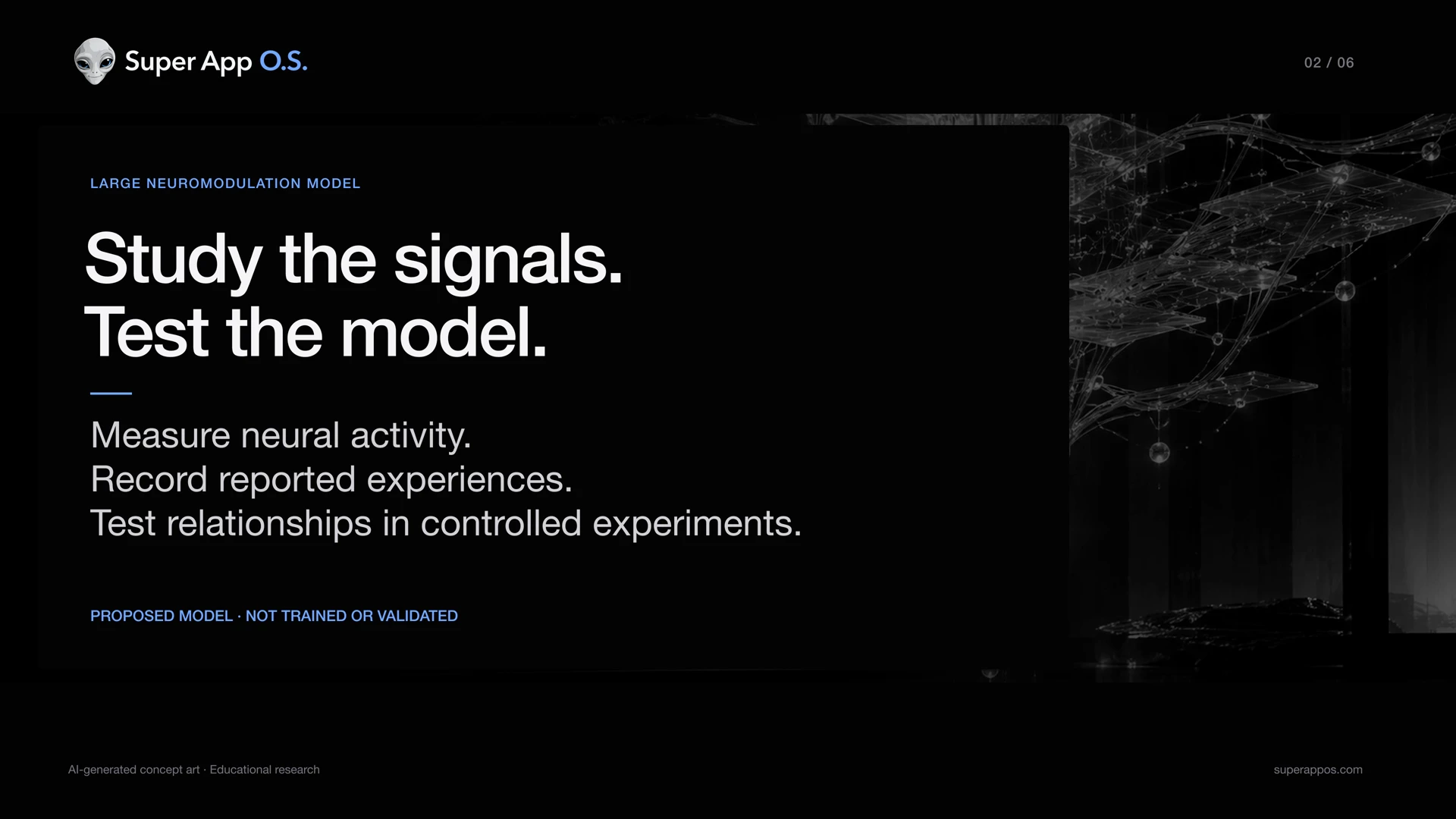
White Noise proposes a Large Neuromodulation Model to investigate relationships among measured neural activity, reported experience and AI-generated hypotheses. The long-range conjecture is that modulation of small neural circuits might make reported remote-viewing experiences repeatable on demand. No validated evidence establishes this capability, and no specific small neural circuit has been established as a remote-viewing mechanism.
In principle, a repeatable, measurable state could make experiments easier to compare. Establishing that state, its causal role, and any actual hidden-target information would each require separate evidence.
Adaptive neuromodulation has specific clinical applications. It does not demonstrate remote viewing. No validated remote-viewing circuit, trained LNM, on-demand activation capability, or nonlocal information channel is claimed here. This website offers no neural stimulation controls or instructions.
Read the clinical research and evidence boundaries ↓Organize authorized neural recordings, participant reports and ordinary task outcomes while preserving timestamps, data provenance and withdrawal controls.
A consented observation record. No modulation.Compare possible relationships between neural state and reports. Mark uncertain predictions, alternative explanations and the absence of a validated remote-viewing circuit.
A testable hypothesis with uncertainty.Explore the hypothesis in software. An independent clinical and ethics review would determine whether any human intervention is justified; the AI does not authorize it.
A reviewable simulation and decision record.A qualified research team would compare preregistered outcomes with suitable controls, preserve target blinding and evaluate the original reports separately from generated images.
Results that include uncertainty, null findings and failures.Independent replication would determine what, if anything, merits further work. Translate validated findings into narrower interface requirements for Super App O.S.; retain the White Noise Computer as the speculative horizon.
Evidence-linked requirements, not a capability claim.A narrated visual explainer using three original HD AI images, camera motion, and readable research notes. Andrew’s neural voice is synthesized at 1.25× speech speed; use normal player speed.
Download the 4K film ↓3840 × 2160 export. Source AI artwork is enlarged for the 4K motion composition. Visuals are artistic abstractions, not anatomical maps or a demonstration.
In clinical research, an adaptive system can measure neural activity and adjust an intervention using a defined feedback rule. A 2024 blinded crossover pilot in four people with Parkinson's disease reported improved motor symptoms and quality of life with personalized adaptive deep brain stimulation compared with optimized conventional stimulation. This is evidence for a specific clinical application, not for arbitrary abilities or remote viewing.
LNM is a proposed AI research layer for organizing consented observations, estimating uncertainty and comparing models of neural state. The word large describes the intended model ambition; no trained LNM, benchmark performance or dataset scale is claimed. The first useful artifact would be a software simulation and a preregistered question.
There is no established evidence that neuromodulation activates remote viewing on demand, and no validated small-circuit localization for that claimed ability. Historical reports of unusual results do not establish a reproducible engineering channel or a neural mechanism. The CIA's account of its program describes remote viewing as unreliable for intelligence use. Improved attention, richer imagery or a persuasive AI rendering would not establish access to a hidden target.
Any study involving neural intervention requires appropriately qualified clinical investigators, participant consent, ethics review and applicable regulatory authorization. The website offers a conceptual software journey and no stimulation settings, anatomical targets, treatment protocols or device control. EEG recording kits described elsewhere are not an endorsed neuromodulation system.
Oehrn et al. — Chronic adaptive deep brain stimulation versus conventional stimulation in Parkinson's disease: a blinded randomized feasibility trial ↗
Louie et al. — Adaptive deep brain stimulation for dynamic gait control in Parkinson's disease: a randomized feasibility trial ↗
Even a replicated experimental anomaly would not by itself identify quantum entanglement as its cause. Established quantum teleportation requires classical communication and cannot transmit information faster than light. The White Noise Computer remains an imaginative architecture to investigate, rather than an available destination for neural commands.
The company plans to build Super App O.S. as an operating system for the proposed White Noise Computer. LNM is one possible research direction within that vision, not a demonstrated prerequisite, trained model, clinical system or working nonlocal interface.
The first milestone is a clear software contract for observation, consent, uncertainty, human review, and reproducible evaluation. Any future physical interface depends on independent scientific and engineering validation.
Explore the Super App O.S. roadmap