

LEARNING / ACADEMY
Build your understanding.
Follow a research question through signals, evidence, and a clearly documented experiment.
Explore AcademyOne proposed membership combining White Noise research education, a custom development workspace, and business intelligence for category creation in an age of accelerating AI.
Remote viewing is also taught on the membership platform through Academy, exploring its proposed relevance to computing and the broader GNR fields of genetics, nanotechnology, and robotics within the White Noise research vision.
A limited public AI preview and the local Studio sample are available now. Academy full lessons are reserved for active members. Academy + Studio is planned at $100 / month, with enrolment and availability confirmed by enquiry.

Follow a research question through signals, evidence, and a clearly documented experiment.
Explore Academy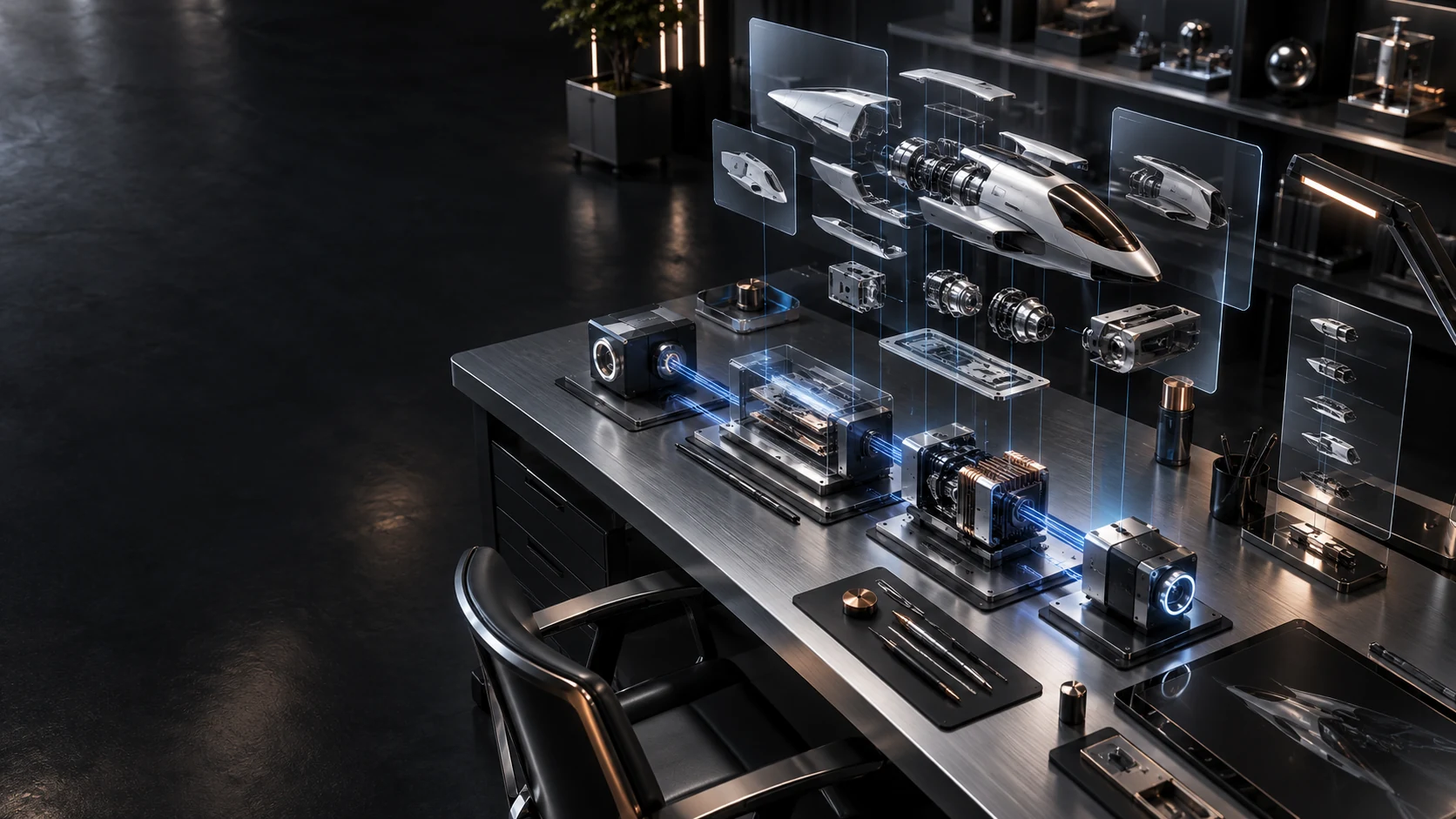
Define the interface, build a bounded prototype, and leave a useful path for the next developer to fork.
Explore development kits
Connect a particular audience with an unmet problem, a distinct offer, and evidence that could change your mind.
Draft a category briefWork with a central Qwen chatbot and five specialist modes to develop a business category in the Super App O.S. ecosystem.
Try the public AI previewThese original artworks imagine learning and development environments. They do not depict operating White Noise Computer hardware or actual member facilities.
A central Qwen conversation connects five specialist perspectives: computer architecture, remote-viewing research, app development, category strategy, and evidence review.
Every mode helps you work through the same practical questions: who is this for, what remains unresolved, what should the category be called, what is the point of view, what can you offer now, and which launch experiment would test it?
The preview is subject to usage limits shown in the workspace. Conversations are held in page memory; prompts are sent to Vercel and the model provider. Keep confidential, neural, and medical records out of the chat.
A dedicated film is being prepared around Academy learning, AI tools, category design, and app prototyping. Explore the four original visual worlds above and use the public AI workspace now.
Open the AI workspaceStudy the Totality concepts alongside established computing, signal analysis, experiment design, and the limits each technology brings.
Turn a space-app idea into a scoped brief, interface requirements, simulation plan, and a fork that another developer can understand.
Map audiences, alternatives, assumptions, and evidence. Shape a distinct category proposition before making market or capability claims.
A proposed review practice would connect learning and development through research notes, versioned decisions, and explicit next tests.
Academy learning paths, custom development planning, and business intelligence in one proposed member offering.
Enrolment by enquiry. Confirm availability, included access, and service terms before joining. This website does not collect payment or create an account.
The Academy preview and course outline are public; full lesson playback requires active member access. Enrolment, lesson availability, and any Studio services are confirmed by enquiry. Third-party AI subscriptions are not included by implication.
BCI fundamentals, signals and noise, consent, blinded evaluation, AI image provenance, and quantum-information boundaries.
Translate OSTSS, White Noise Computer, and transformer-app concepts into conventional software interfaces and synthetic demonstrations.
Explore the problem a future product could solve, how people address it today, and what evidence would justify a different approach.
Study a specific audience, its current alternatives and the cost of an unsolved task. Create a category hypothesis only after you can explain the problem.
Learning artifact: An audience/problem brief and a category hypothesis.
External reading · Category PiratesLearn to distinguish a customer observation, a source-backed fact, an estimate and a speculative premise. Keep freshness and uncertainty beside the claim.
Learning artifact: A dated evidence register with open questions.
White Noise · bounded research routesDevelop an original point of view and a concise category narrative that connects a customer problem with a useful, testable product direction.
Learning artifact: A one-page positioning draft and a message test.
External reading · Category Design AcademyCompare several possible rates of technical change. Define what someone might pay for now and which future capabilities remain assumptions.
Learning artifact: A business model experiment with three scenario notes.
White Noise · strategy and service boundariesStudy the White Noise Computer as a speculative architecture, then implement a conventional workspace for queries, sources, model outputs and review records.
Learning artifact: A software architecture sketch and a working local demonstration.
White Noise Computer · concept and current boundaryLearn signal recording, report labels and evaluation with synthetic or licensed data. Distinguish task recognition from claims about unseen targets.
Learning artifact: A reproducible toy pipeline and an evaluation plan.
MOABB · open-source BCI evaluationConnect settlement, robotics, fabrication and fleet ideas to a small simulation or decision tool. Begin with one user and one inspectable output.
Learning artifact: A scoped Space Super App prototype brief.
White Noise Academy · connected learning topicsPublish what the software actually does, attach the sources and give other builders a clear starting point for their own version.
Learning artifact: A release note and a reviewable project handoff.
White Noise Library · source and reuse boundariesThere is no validated recipe for constructing a White Noise Computer. The useful development path starts with the components we can specify, simulate, and test.
Choose a bounded task: organize a session record, compare image hypotheses, model habitat resources, or preview a mission request. Specify inputs, outputs, and failure states.
Implement the task with ordinary software and synthetic or appropriately authorized data. Keep BCI adapters separate from application logic and review provider access requirements.
Set a baseline and a rejection criterion before testing. Preserve failures. A usable interface does not establish remote viewing or nonlocal information access.
Export the specification, document dependencies, and suggest one modification. Future physical interfaces remain conditional on independent scientific validation.
Choose an app concept, describe the person it serves, select a software capability and define the evidence your prototype should produce. Develop the business case alongside the technical plan.
Build a conventional research workbench that explores the proposed Computer’s interface. Physical entanglement computation and arbitrary nonlocal information retrieval remain unvalidated.
This produces software on ordinary computers. No hardware recipe for a White Noise Computer is established.
White Noise ComputerTranslate a project-library idea into one useful digital tool and a clear next development decision.
Simulated fabrication requests and robot actions stay inside the model; they do not control OSTSS infrastructure.
White Noise OSTSSPrototype a research record rather than a claimed remote-viewing instrument. Start with synthetic reports and images before considering any participant study.
No reliable remote-viewing mechanism, small-circuit activation method or quantum communication channel is supplied.
White Noise R.V.I.S.Explore a distinct market position by connecting a particular customer problem with a product people can understand and test.
Original planning exercises informed by public reading; no Category Pirates affiliation, licensed curriculum or guaranteed category leadership.
Category Pirates · independent external readingThe technological singularity is a speculative scenario, not a dated business forecast. Compare several futures and choose useful work that does not depend on one arriving.
Assumption: AI remains fallible; progress comes from better interfaces, curated data and ordinary software engineering.
Build evidence libraries, learning tools, transparent simulations and research workflow software.
Watch for: Repeated use, reduced rework, clearer decisions and customers choosing the tool over their existing process.
Next milestone: Demonstrate one useful task on current hardware.
Stop or revise: Re-scope if users cannot identify a meaningful improvement or a recurring need.
Assumption: Models become more capable or less costly, while evaluation, data rights and human review remain necessary.
Test richer design assistants, accessible interfaces and verified automation within existing workflows.
Watch for: Measured quality, reliability and cost improvements on the same benchmark with the same evaluation rules.
Next milestone: Swap a model adapter and show a reproducible benefit without changing the promised task.
Stop or revise: Retain the previous workflow when a new model increases errors, costs or unreviewable actions.
Assumption: A currently unvalidated physical claim receives independent, reproducible support. This is a hypothetical scenario with no promised date.
Revisit interface requirements, dependencies and governance only for capabilities the evidence actually establishes.
Watch for: Independent replication, credible technical review and a precise account of what was demonstrated.
Next milestone: Commission a feasibility review before promising a new product or integrating real hardware.
Stop or revise: Keep the capability in the research lane if replication, safety, access or practical utility remains unresolved.
Give an idea a problem, an audience, and a testable reason to exist.
This sample turns your inputs into a structured strategic brief. It uses transparent templates and local rules; it does not call an AI model, research competitors, verify demand, or forecast financial returns. Your inputs stay in this page’s memory until you leave or reset.
The Studio takes broad inspiration from the idea of category creation: helping people recognize a problem and consider a different way to address it. Category Pirates publishes its own books, education, and tools on this subject.
This is an original Super App O.S. planning tool. It is not affiliated with, endorsed by, or a reproduction of Category Pirates’ proprietary materials. A distinct category proposition still needs customer evidence and honest capability claims.
Discuss the proposed membership and the research or software artifact you want to create. Availability and commercial terms will be confirmed through White Noise.