
The settlement is an interface.
How a space super app can turn the scale of White Noise Totality into systems people can inspect, simulate, and fork.
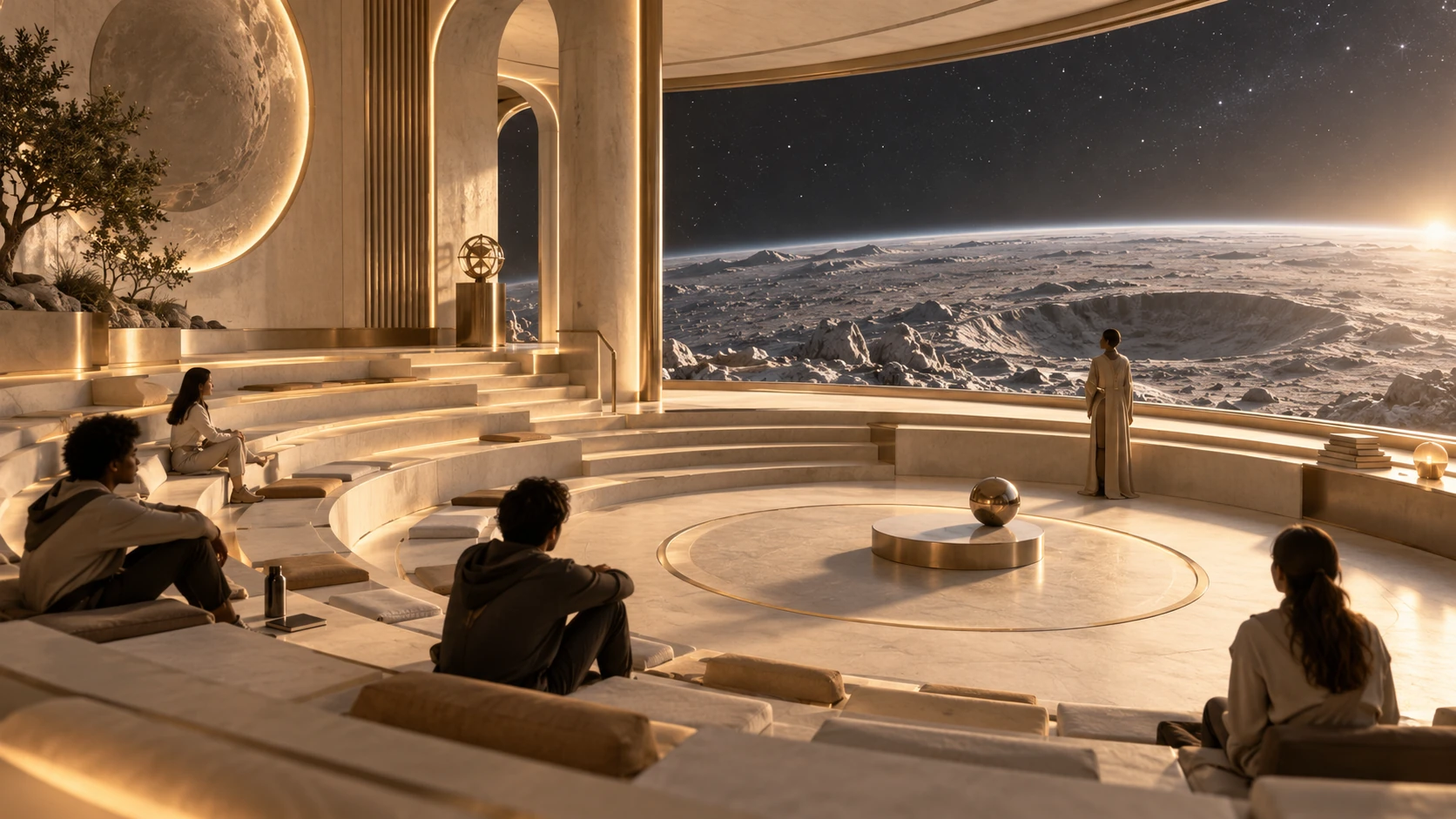
Begin with the person inside the system
Imagine arriving in a settlement whose walls can change, whose factories are distributed, and whose infrastructure is coordinated by software. The first useful screen would probably answer a surprisingly ordinary question: where can I go, and what is working? A civilization of extraordinary machines still needs comprehensible everyday interfaces. This is the design opportunity behind Super App O.S.
White Noise Totality supplies the larger imaginative setting: computation woven into reality, transformative fabrication, and settlements that extend themselves. White Noise’s public OSTSS page describes a speculative infrastructure thesis in which small building systems grow into habitats. Super App O.S. proposes an application layer for exploring that thesis. The immediate material is a library of models, interfaces, and research questions; the distant architecture is the Omnipresent Singulitarian Transformer Space Settlement.
Give every transformation a readable contract
A transformer app could begin with a request as simple as adapting a communal room for a different activity. In a simulation, that request should show its proposed effect, resource requirements, assumptions, permissions, and recovery path. The interface makes change discussable before anything moves. A beautiful preview becomes more useful when another person can inspect the decisions behind it.
At the far horizon, the White Noise Computer would coordinate the supernanobots and macrobots imagined in the Totality framework. Today, a software developer can represent those actors as simulated agents with limited capabilities. Give each agent an inventory and a clearly defined task. Record failures as well as completed actions. This creates a place to ask architectural questions without presenting speculative machines as existing hardware.
The same structure could support a United Space Fleet mission planner, a habitat resource model, or a Replicator job preview. A request to fabricate a ship would remain a simulated submission with a visible bill of assumptions. It would not imply an active signal channel to an OSTSS or a working matter-synthesis system.
Fork the question as well as the interface
An app concept becomes more valuable when it gives the next developer somewhere specific to begin. A useful fork might change one resource constraint, replace a simulated sensor, or redesign a screen for someone using an assistive input device. The new project should preserve the original scenario and explain what changed. That makes the fork a contribution people can compare.
Consider a settlement water dashboard. One branch might explore how residents understand uncertainty. Another might test a maintenance scheduling interface. A third could model a temporary interruption with entirely synthetic data. These projects share a concept while developing different evidence. None requires the entire White Noise architecture to exist before the design work can be useful.
For this library, a strong starting package includes a short problem statement, example inputs, expected outputs, known limits, and a small demonstration. It also identifies which material may be reused. An invitation to fork should make the practical starting point as visible as the visual ambition.
Design for a future resident
The defining quality of a space super app may be its ability to keep a complicated environment understandable. Residents need to distinguish a proposal from an approved change, a model from a measurement, and a graceful animation from a completed physical action. Those distinctions belong in the interface itself.
White Noise Totality gives Super App O.S. a large canvas. The work of the application designer is to choose a human-sized piece of that canvas and make it legible. Start with one room, one route, one inventory, or one research record. Let the next builder fork it. A settlement can begin as a shared language for asking better questions.