
Living systems beyond Earth.
The most ambitious settlement software begins with the conditions that make an ordinary day possible.
The habitat is part of the interface
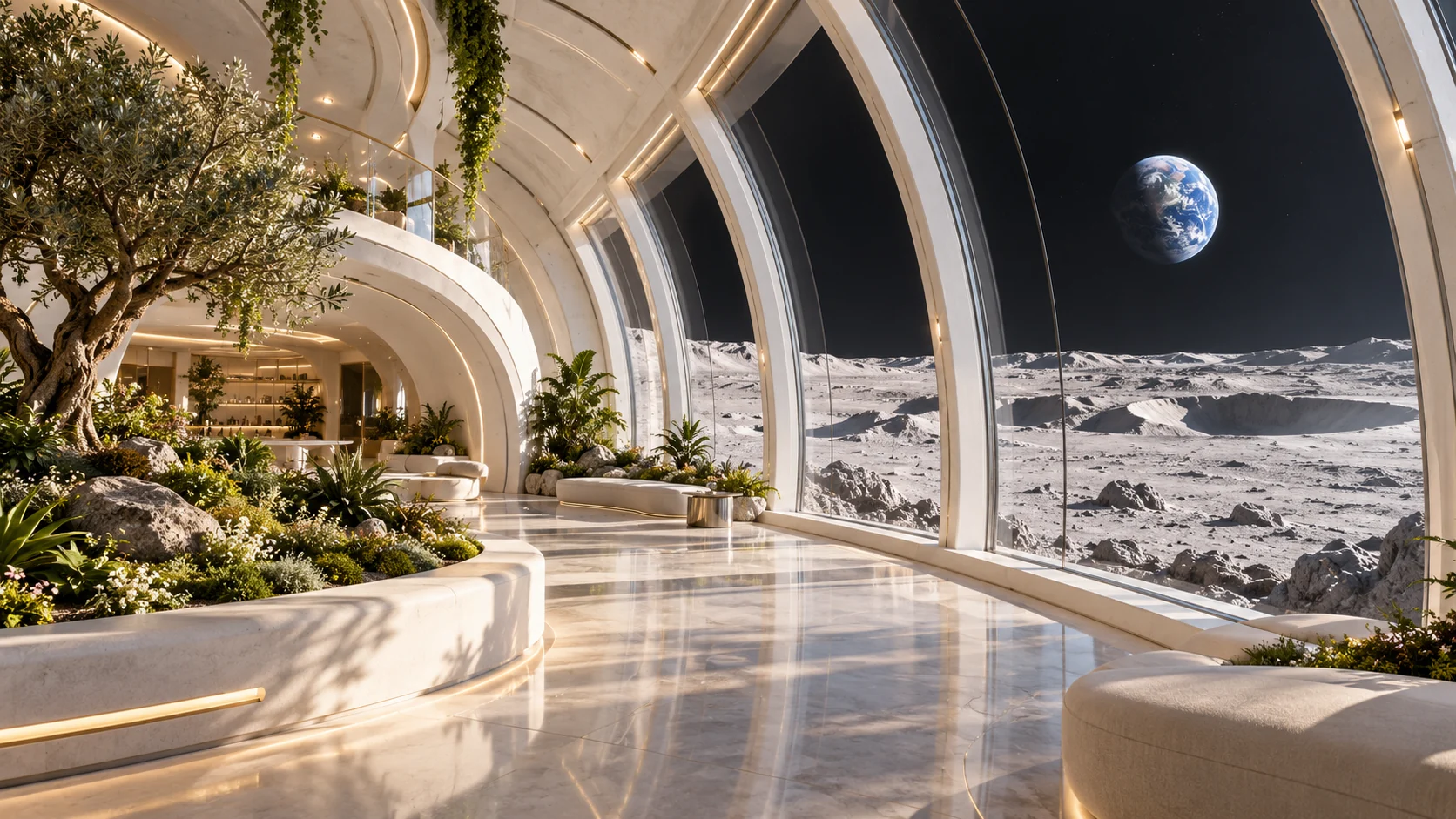
A garden under an orbital sky is an evocative image. What makes it a habitat, however, is everything the image cannot show: a reliable water supply, maintained equipment, understandable responsibilities, and people who can respond when conditions change. For Super App O.S., living systems offer a particularly rich bridge between the scale of Totality and the realities of software design.
NASA’s description of the International Space Station’s environmental control and life-support systems provides a concrete reference point. Air, water, oxygen, ventilation, waste management, and other functions depend on engineered systems. These are interacting responsibilities with their own checks and maintenance demands. A settlement interface should help people understand those relationships without suggesting that a screen itself guarantees a safe environment.
Give the DMS a useful first boundary
Within the requested Super App O.S. vision, White Noise DMS is a Digital Medical System concept associated with the OSTSS framework. Its long-range themes include longevity, genomics, biotechnology, and expanded human capability. Immortality and extraordinary enhancement remain speculative ambitions; an app cannot activate them. The useful first design problem is how to organize knowledge and consent around such an expansive research agenda.
A proposed DMS research workspace could link a question to its sources, show the quality and limits of supporting evidence, and record which claims have changed after review. A separate demonstration could use synthetic records to explore accessibility and permission settings. Neither requires diagnoses, treatment recommendations, or real personal health data to make the interface worth evaluating.
The distinction between habitat information and individual information deserves particular care. A resident may need to see a shared environmental notice while keeping their personal records private. Designers can explore that difference with fictional scenarios: who can view a record, who can correct it, and what appears when access is unavailable? These are consequential product questions long before clinical deployment.
Model the handoffs
Many failures in a complex environment can emerge between otherwise understandable tasks. A maintenance window changes a room’s availability. A delayed delivery alters the spare-parts plan. A new research activity needs a different space allocation. A useful habitat simulation makes those handoffs visible so a developer can ask whether the right people receive the right information at the right time.
One fork could focus on a greenhouse operations board using synthetic readings. Another could build a research literature map. A third might prototype an accessible appointment interface with fictional participants. A fourth could explore how a community reviews proposed changes to shared spaces. Each project can have its own clear scope while contributing to a common settlement vocabulary.
For these prototypes, realistic uncertainty is more useful than perfect fictional performance. Let a sensor report be late. Let two records disagree. Let an action require review. The interface then has to express uncertainty, correction, and responsibility in ways a person can understand. This is where an attractive concept starts to reveal whether it is thoughtfully designed.
Build the conditions for an ordinary day
White Noise’s OSTSS thesis imagines habitats that grow and coordinate themselves. Our interpretation for Super App O.S. is that increasing autonomy should make responsibility easier to inspect. A resident should be able to see whether information is measured, inferred, or simulated, and how to reach a human when the system cannot resolve a question.
The goal of this project library is to give that interpretation a practical form. Start with a modest scenario, document its assumptions, and make it possible for another developer to improve it. The future habitat can remain expansive in imagination while its first app helps someone understand one small part of a living system. That is a credible foundation for a much larger design conversation.